
How it differs from a funeral program
A celebration of life program and a funeral program are built the same way. Both are usually one sheet of US Letter paper, printed on both sides and folded in half, with a cover, two inside pages and a back. The differences are in what you put on those pages.
A funeral usually follows the order set by a church or a funeral home. A celebration of life is planned by the family, often in a park pavilion, a restaurant, a backyard or a lodge, and the order is whatever the family wants. The program becomes the only written plan most guests see, so it does more work.
The wording is lighter too. Covers say “Celebrating the life of” or “A life well lived” more often than “In loving memory”. The inside page might be called “Order of the afternoon” or simply “Program”, and its lines name songs, stories and activities instead of hymns, prayers and readings.
Many celebrations happen two to six weeks after the death, sometimes after a private burial or a cremation. That gives you more time to write, collect photos and print, and it means the cover dates and the gathering date can be weeks apart.
People who have only been to church funerals may not know if they can speak, what to wear or whether to stay. A line about the open microphone, the dress code or the meal answers those questions before anyone has to ask.
Faith can still be part of it. Plenty of celebrations include a pastor, a prayer or a psalm alongside the stories and music. If you want ideas for the gathering itself, see celebration of life ideas.
A typical order of events
The planned part of a celebration of life usually runs 30 to 60 minutes. This order works for most gatherings, and you can drop or move any of it.
- Gathering music: a playlist of their songs as guests arrive
- Welcome from the host, usually a family member or close friend
- A song that meant something to them, played all the way through
- A reading, a poem or a short prayer
- Their life story, read by a family member
- Stories from two or three planned speakers, about five minutes each
- A photo slideshow
- Open microphone for anyone who wants to share a memory
- A shared moment: a toast, a song everyone sings, or planting something
- Closing words and an invitation to stay for food
Ask your planned speakers ahead of time, and give each one a rough length. For the open microphone, ask two people in advance to go first so nobody has to break the silence. If the slideshow plays during the program, the funeral slideshow page has a guide to how many photos fit a song or two.
What to put on each page
The cover
The cover carries a heading, the full name, the birth and death dates and a photo. Add the date, time and place of the gathering, including the city if guests are traveling. A celebration of life is a good place for the name people actually used (“Bill”, “Aunt Dot”, “Coach”) and for a short line under the name, such as “Forever on the trail” or a phrase they often said.
Choose a photo that looks like them on a good day. For a celebration, families often pick a candid one: at the lake, in the garden, holding a grandchild. Make sure the face is large and sharp enough to print at about four inches tall.
Inside left: the order of events
List each part in order, with the name and relationship of whoever leads it: “Welcome · Nancy Price, daughter”. If a song is played, give its title and, if you like, who plays it. Guests use this page to follow along, so keep each line short.
Below the order, many families add honorary pallbearers or a “with thanks to” line for the people who helped: the friend who hosted, the band that played, the neighbors who cooked.
Inside right: their life story
This is a shortened obituary of about 150 to 300 words. For a celebration, lean toward the stories and habits people will recognize: the boat they named after their wife, the notebook of every trail they walked, the dish they brought to every potluck. If you need help, how to write an obituary covers what to include, and the obituary examples show different tones. A favorite saying or a short quote fits under the story.
The back page
The back holds a poem or reading, a thank-you from the family, and practical details: where the food is, any charity for donations, and anything you would like guests to take or do. The funeral poems page has full texts you can print. If you are giving out a keepsake, such as seed packets or a recipe card, say so here.
Two filled-in examples
Both of these are real designs from this site, filled in with fictional families. Open “Read every word of this program” under each one to see all the wording.
A ranger’s celebration at a mountain lodge
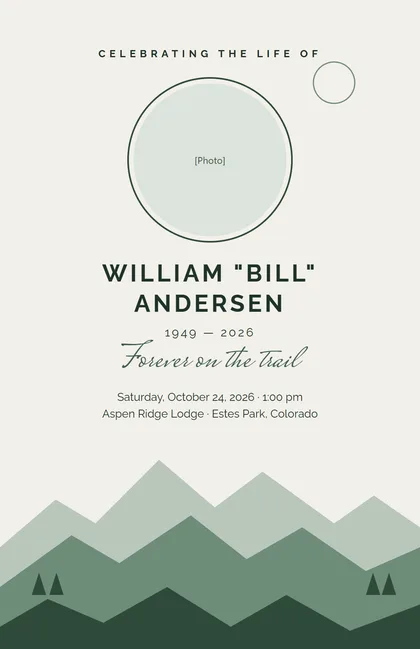 Front
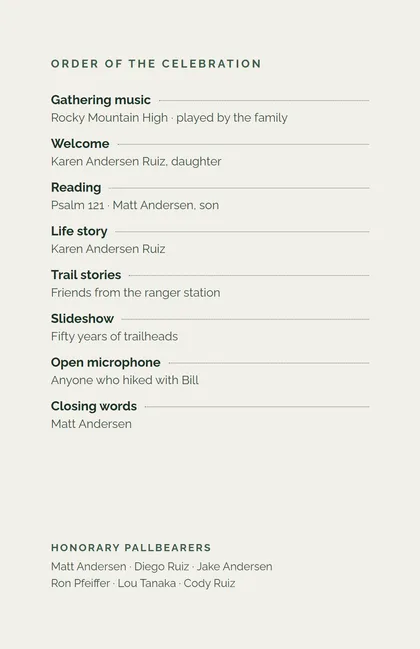 Inside left
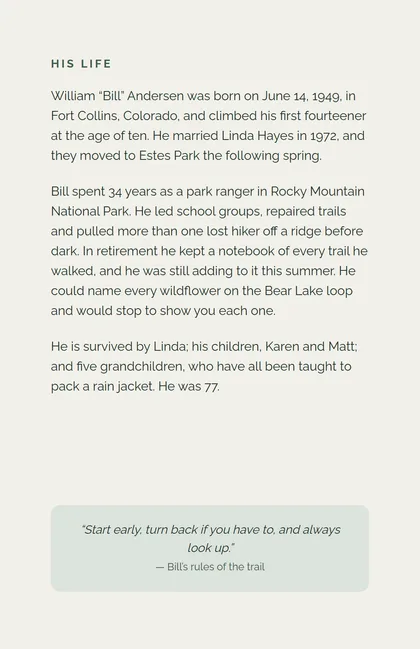 Inside right
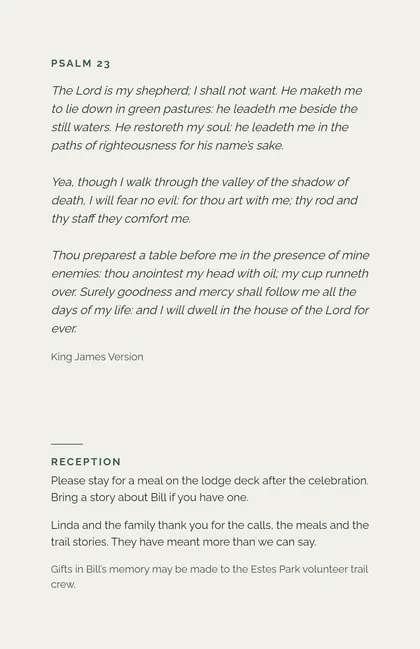 Back
Read every word of this program
Front
Celebrating the life of
William "Bill" Andersen
June 14, 1949 – October 15, 2026
Forever on the trail
Saturday, October 24, 2026 · 1:00 pm
Aspen Ridge Lodge, Estes Park, Colorado
Order of the celebration
- Gathering music
- Rocky Mountain High · played by the family
- Welcome
- Karen Andersen Ruiz, daughter
- Reading
- Psalm 121 · Matt Andersen, son
- Life story
- Karen Andersen Ruiz
- Trail stories
- Friends from the ranger station
- Slideshow
- Fifty years of trailheads
- Open microphone
- Anyone who hiked with Bill
- Closing words
- Matt Andersen
Honorary pallbearers: Matt Andersen · Diego Ruiz · Jake Andersen · Ron Pfeiffer · Lou Tanaka · Cody Ruiz
His life
William “Bill” Andersen was born on June 14, 1949, in Fort Collins, Colorado, and climbed his first fourteener at the age of ten. He married Linda Hayes in 1972, and they moved to Estes Park the following spring.
Bill spent 34 years as a park ranger in Rocky Mountain National Park. He led school groups, repaired trails and pulled more than one lost hiker off a ridge before dark. In retirement he kept a notebook of every trail he walked, and he was still adding to it this summer. He could name every wildflower on the Bear Lake loop and would stop to show you each one.
He is survived by Linda; his children, Karen and Matt; and five grandchildren, who have all been taught to pack a rain jacket. He was 77.
“Start early, turn back if you have to, and always look up.” (Bill’s rules of the trail)
Back
Psalm 23, King James Version
The Lord is my shepherd; I shall not want. He maketh me to lie down in green pastures: he leadeth me beside the still waters. He restoreth my soul: he leadeth me in the paths of righteousness for his name’s sake. Yea, though I walk through the valley of the shadow of death, I will fear no evil: for thou art with me; thy rod and thy staff they comfort me. Thou preparest a table before me in the presence of mine enemies: thou anointest my head with oil; my cup runneth over. Surely goodness and mercy shall follow me all the days of my life: and I will dwell in the house of the Lord for ever.
Reception: Please stay for a meal on the lodge deck after the celebration. Bring a story about Bill if you have one.
Linda and the family thank you for the calls, the meals and the trail stories. They have meant more than we can say.
Gifts in Bill’s memory may be made to the Estes Park volunteer trail crew.
Bill Andersen’s family titled the inside page “Order of the celebration”. It starts with a song played by the family, then a psalm read by his son, his daughter reading his life story, trail stories from his friends at the ranger station, a slideshow called “Fifty years of trailheads” and an open microphone for anyone who hiked with him. The cover note, “Forever on the trail”, and his rules of the trail under the life story make the program sound like him. The reception line asks guests to bring a story, which tells them the stories will keep going over the meal. The Mountain design uses this layout.
A captain’s celebration by the water
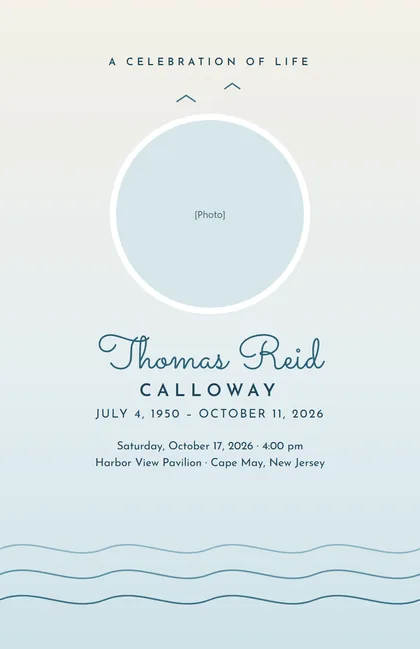 Front
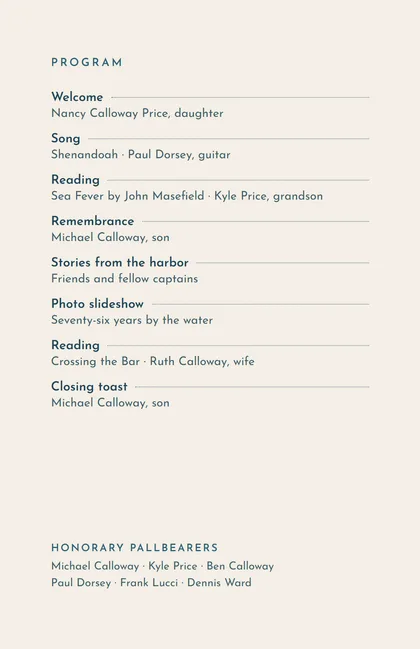 Inside left
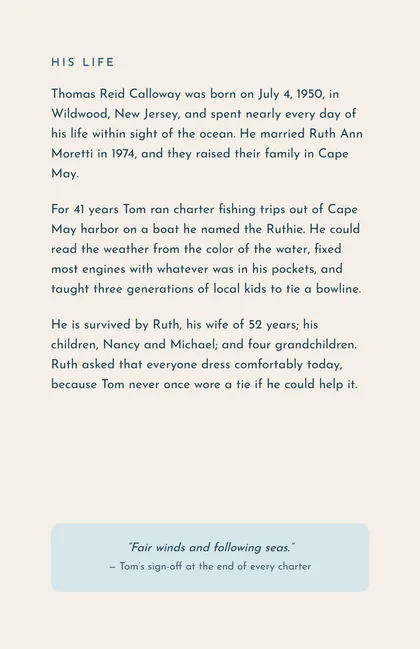 Inside right
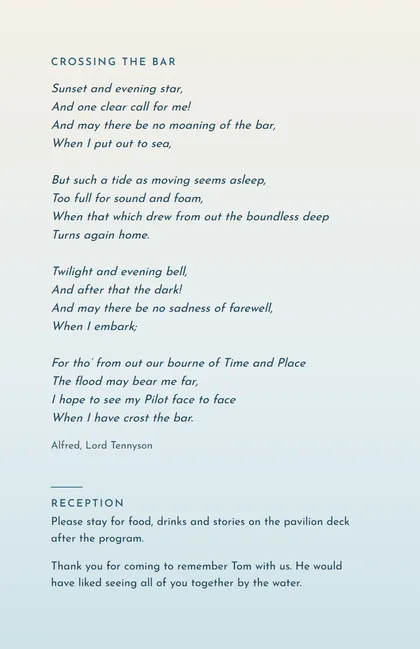 Back
Read every word of this program
Front
A celebration of life
Thomas Reid Calloway
July 4, 1950 – October 11, 2026
Saturday, October 17, 2026 · 4:00 pm
Harbor View Pavilion, Cape May, New Jersey
Program
- Welcome
- Nancy Calloway Price, daughter
- Song
- Shenandoah · Paul Dorsey, guitar
- Reading
- Sea Fever by John Masefield · Kyle Price, grandson
- Remembrance
- Michael Calloway, son
- Stories from the harbor
- Friends and fellow captains
- Photo slideshow
- Seventy-six years by the water
- Reading
- Crossing the Bar · Ruth Calloway, wife
- Closing toast
- Michael Calloway, son
Honorary pallbearers: Michael Calloway · Kyle Price · Ben Calloway · Paul Dorsey · Frank Lucci · Dennis Ward
His life
Thomas Reid Calloway was born on July 4, 1950, in Wildwood, New Jersey, and spent nearly every day of his life within sight of the ocean. He married Ruth Ann Moretti in 1974, and they raised their family in Cape May.
For 41 years Tom ran charter fishing trips out of Cape May harbor on a boat he named the Ruthie. He could read the weather from the color of the water, fixed most engines with whatever was in his pockets, and taught three generations of local kids to tie a bowline.
He is survived by Ruth, his wife of 52 years; his children, Nancy and Michael; and four grandchildren. Ruth asked that everyone dress comfortably today, because Tom never once wore a tie if he could help it.
“Fair winds and following seas.” (Tom’s sign-off at the end of every charter)
Back
Crossing the Bar, Alfred, Lord Tennyson
Sunset and evening star, And one clear call for me! And may there be no moaning of the bar, When I put out to sea, But such a tide as moving seems asleep, Too full for sound and foam, When that which drew from out the boundless deep Turns again home. Twilight and evening bell, And after that the dark! And may there be no sadness of farewell, When I embark; For tho’ from out our bourne of Time and Place The flood may bear me far, I hope to see my Pilot face to face When I have crost the bar.
Reception: Please stay for food, drinks and stories on the pavilion deck after the program.
Thank you for coming to remember Tom with us. He would have liked seeing all of you together by the water.
Tom Calloway’s program is just called “Program”, which suits a late-afternoon gathering at a harbor pavilion. His daughter welcomes everyone, a friend plays “Shenandoah” on guitar, his grandson reads Masefield’s “Sea Fever” and his friends and fellow captains tell stories from the harbor. His wife reads “Crossing the Bar” near the end, and his son closes with a toast. The life story ends by telling guests to dress comfortably, because Tom never wore a tie if he could help it. A line like that does the job of a dress code. The Coastal design uses this layout.
For more complete programs, including church and military services, see the funeral program examples.
Wording you can use
Copy any of these and change the names and details.
Cover headings
Titles for the inside page
Welcome lines
These work printed at the top of the inside page or read aloud by the host.
Thank-you lines for the back page
Reception, dress and requests
For the cards you send after the gathering, see funeral thank you card messages.
Printing and timing
Start with the order of events, because it depends on other people. Confirm each speaker, musician and reader before their name goes in print, and check with the venue about music and screens. Write the life story while you wait to hear back. The back page comes last, since the food plans and the charity often settle a few days before.
Print one for each guest you expect, plus about 15 percent extra. Families often mail a few to relatives who couldn’t come. Every design here is free to edit and download, with no sign-up and no watermark: a PDF for double-sided printing at home, a print-shop PDF with bleed and crop marks, or a JPG of the front to share by text or email. A JPG of the cover also works as a simple invitation. Before you print the full batch, print one copy, fold it, and have someone else read every name and date.
Celebration of life invitation templates
What goes in a memorial service program
Questions people ask
What is the difference between a funeral program and a celebration of life program?
The layout is the same: a cover, an order of events, a life story and a back page. A celebration of life program uses a lighter heading, lists songs, stories and activities more than hymns and prayers, and often tells guests what to expect, such as an open microphone or a meal afterward.
Do you need a program for a celebration of life?
No, but it helps when the gathering is informal. Guests know when the stories start, who is speaking and when to stay for food, and the family has a keepsake with the photo and the life story.
What should the cover of a celebration of life program say?
A heading such as "Celebrating the life of" or "A life well lived", the full name, the birth and death dates, a photo, and the date, time and place of the gathering. A nickname or a short line they often said can go under the name.
How long is a celebration of life?
Most run one to three hours. The planned part, with the welcome, speakers and songs, usually takes 30 to 60 minutes, and the rest is food and conversation.